Thirty small jobs, every single week.
Running a small consultancy meant 30+ recurring ops tasks eating evening hours: backup audits, scraper health checks, log triage, GitHub repo sweeps, EA backtest summaries, Telegram triage. None of them complex on their own — collectively, they consumed 6–8 hours every week.
Hiring an ops person wasn't justified at this scale. The right answer was a multi-tool AI co-pilot — but the off-the-shelf AI products that existed in 2025 were either too narrow (single-purpose chatbots) or too dangerous (general agents with full shell access and no guardrails). So we built one.
Telegram front-end. Scoped shell back-end. Hard permission boundary.
Front-end: Telegram bot, because that's where the operator already lives all day. No new UI to learn, no new tab to keep open.
Planner: Anthropic Claude as the reasoning layer — chosen for tool-use reliability and the ability to refuse ambiguous instructions instead of guessing.
Tool layer: a tightly scoped allowlist of shell commands and Python scripts. Anything destructive (file delete, repo force-push, system service restart) requires explicit operator confirmation in chat.
Permission model: two protected paths the agent can never touch, regardless of instruction — written into the system prompt AND enforced at the tool layer. Belt and braces.
The work it took off our plate.
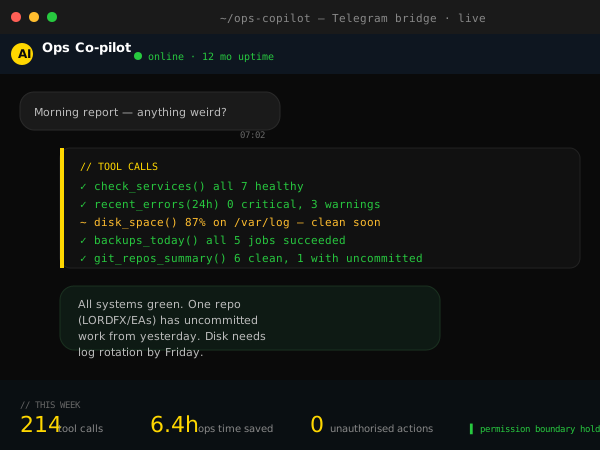
- ✓Recurring health checksEvery morning: status of services, recent error counts, disk space, last successful backup. One Telegram message, takes 8 seconds to read.
- ✓Log triage & summarisation"Anything weird in last night's logs?" — the agent reads, clusters by pattern, summarises in plain English.
- ✓Repo sweepsUncommitted changes across 7 active repos, stale branches, last-pushed-N-days-ago. Surfaces what needs attention.
- ✓On-demand backtests"Run the GBP triangular-arb test on last week's tick data." Agent fires the script, waits, summarises results into chat.
- ✓Inbound intent routingTelegram messages from outside operators get classified — urgent, FYI, marketing spam — and routed accordingly.
- ✓Session backup automationEvery Claude session auto-archived as JSONL + human-readable transcript, with retry on failure.
Twelve months. Still running.
Zero unauthorised actions in 12 months of operation. The permission boundary has caught the agent attempting to touch protected paths twice — both times it correctly stopped and asked for confirmation, exactly as designed.
"I built the first version as a weekend proof. A year later it's still the thing that runs my ops queue every morning. The architecture we now offer clients on the AI Co-pilot tier is the exact same one — battle-tested first on my own work."
— Founder, GetWebLabs